
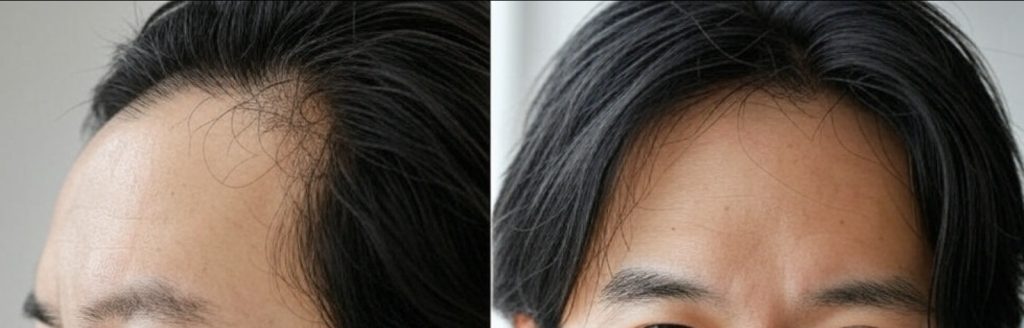
10年ほど前から風呂の度にゾッとし始め、即、AGA治療を開始。
与えられたミノキシジルを飲むも一月後位で増々抜ける髪の毛。
服用初期症状とのことで、更に半年ほどミノキシジルを続けるも、
治療前の写真と比べてやっぱり薄い。
治療院を変えて与えられたザガーロを更に半年ほど。
これが効いているのか?1年という時間なのかは不明だが、写真比べでは
治療前とほぼ同じにはなっている。
しかし、この1年の間に「痛風」発症だの、発疹だの諸々の今までに無い
自分の身体を覚える。
もうそう言う歳なんだと、諦め半分、いやまだまだ俺はイケるんだと言う
想いもチラリと。
禿よりも「痛風」が俺の研究心を騒がせた。
籠った結果、Gary Brecka(生物学者)氏の「メチル化」に辿り着いた。
理解をするのには簡単ではない。でも、俺がフサフサの髪の毛を取り戻すために
やった事はそう難しくない。
①AGA治療という内の薬はやめた。
②サプリメントは補充した。
③リーブ21のマックセルを買った。(代替え品多数あり)
④食事を変えた。
⑤食事をしない時間をつくった。
⑥海兵隊式呼吸法を意識してやった。
⑦CBDハーブ液を加湿器に加えた。
⑧逆立ちを意識してした。
⑨しゃぼん玉石鹸で頭も洗って、時折コーヒー粕も加えた。
⑩ローズマリーオイルでマッサージした。
以下が、俺をそうさせたロジック。
どう取り入れるかはあなた次第。参考にされれば幸い。
【メチル化】
メチル化とは、化学用語で、さまざまな基質にメチル基(CH3)が結合または置換することを意味する。
生物学や生化学、化学の分野で用いられる。
【DNAのメチル化】
•DNAの塩基配列のシトシン(C)の5位にメチル基が付加される化学修飾
•遺伝子のプロモーターやエンハンサー領域で転写因子の結合を阻害し、
遺伝子の発現を抑制する
•正常な発生に必須の機構で、クロマチンの安定性、遺伝子刷り込み、
X染色体の不活化や発がんなどに関与している
•がん細胞では、がん抑制遺伝子の発現がCpGアイランドの異常なメチル化によって抑制されている
【ヒストンのメチル化】
•ヒストン分子のアルギニンやリジン残基に生じ、遺伝子発現の促進、抑制、どちらにも働きます
•例えば、Set1というヒストンメチル化酵素がヒストンH3の4番目のリジンをメチル化すると、
遺伝子の発現が促進されます
【DNAメチル化阻害薬】
•アザシチジン(AZA)、デシタビン(DEC)などの薬剤が使用されており、がん細胞にDNAの低メチル化を誘導し、
がん抑制遺伝子の発現回復を期待している。
【抜け毛は単に DHT の問題では無い】
DHT(ジヒドロテストステロン)は、男性ホルモンの一種で、テストステロンと5αリダクターゼという
酵素が結合して生成される。
【DHTの役割】
•胎児期に男性の外生殖器を形成する
•思春期に陰毛や体毛、陰茎、精巣の発達を促す
•筋肉の発達をサポートし、筋力の維持や増強を助ける
•骨格に影響を与える
【DHTの悪影響】
•成人期にAGA(男性型脱毛症)や皮脂量の増加、ニキビ、前立腺肥大などの原因となる
【DHTとテストステロンの関係】
•テストステロンは筋肉量や骨密度の維持など、男性らしい身体を形成・維持するために必要なホルモン
•テストステロンはAGAや肌荒れとの関連はないと考えられている
•ジヒドロテストステロンの分泌量は5αリダクターゼの分泌量と関連があることが分かっている
DHTは、年代に応じて役割が異なります。思春期以降は、AGAやニキビ、前立腺肥大など、
男性にとってあまり嬉しくない働きをすることから、「悪玉の男性ホルモン」と言われることもある。
【ヒスタミン】
「ランダムな」脱毛を経験する人の多くは、実際にはヒスタミン不耐症またはMCAS(肥満細胞活性化症候群)を患っている。
ヒスタミンは、マグロ、サバ、イワシ、サンマなどの赤身魚やその加工品、発酵食品などに含まれる物質です。
【ヒスタミンを含む食品】
•マグロ、カツオ、イワシ、ブリ、サンマ、サバなどの赤身魚やその加工品
•ワイン、チーズ、ヨーグルト、味噌、醤油、納豆などの発酵食品
•キムチや漬物、お酢などの発酵食品全般
【ヒスタミンによる食中毒】
•ヒスタミンは熱に強く、加熱調理しても分解されないため、気づかずに食べてヒスタミン食中毒を引き起こす可能性があります
•ヒスタミン食中毒の主な症状は、顔面紅潮、頭痛、じんま疹、発熱などです
•ヒスタミン食中毒を予防するには、ヒスタミンを「増やさない」ことが重要です
【ヒスタミン食中毒を予防するには】
•生魚は常温で放置せず、速やかに冷蔵庫で保管しましょう
•魚のエラや内臓は購入後できるだけ早く除去しましょう
•冷蔵の場合でも、できるだけ早く食べましょう
•鮮度が低下したおそれのある魚は食べないようにしましょう
•赤身魚の干物など加工品も、低温保存しましょう
肥満細胞活性化症候群(MCAS)とは、肥満細胞の活動が過剰になり、炎症やアレルギー症状を引き起こす物質を放出することで発生する病気。
【原因】
•肥満細胞の活動が過剰になる
【症状】
•そう痒、紅潮、胃酸過剰分泌によるディスペプシアなど
【診断】
•皮膚もしくは骨髄の生検、またはその両方による
【治療】
•抗ヒスタミン薬の投与、および基礎疾患の制御による
【肥満細胞の働き】
肥満細胞(別名:マスト細胞)は、アレルギー反応を起こす細胞で、刺激を受けるとヒスタミンなどの物質を放出する。
肥満細胞の表面には、IgE(免疫グロブリン)と呼ばれる免疫に関与するタンパク質が付着しています。そこで、アレルゲン(抗原)と
反応するとヒスタミンなどの化学伝達物質を放出し、アレルギー反応を引き起こす。
肥満細胞と関連する疾患には、ぜん息、アレルギー性鼻炎、じんましん、アナフィラキシーショックなどの病気がある。
これにより炎症連鎖反応が発生し、毛包が損傷する。
IBS(過敏性腸症候群)とは、消化器の疾患がないにもかかわらず、慢性的に腹痛や便秘、
下痢などの症状を繰り返す病気。
【主な症状】腹痛や腹部不快感、便秘や下痢などの便通異常、 腹部膨満感。
【原因】
•ストレス、不安、抑うつ、恐怖などの心理的要因
•自律神経の失調
•腸管の運動が異常に亢進し、刺激への反応が過敏になること
【タイプ】便秘型、下痢型、混合型、分類不能型、 ガス型。
【特徴】
•排便によって症状が軽快もしくは軽減する
•社会心理的ストレスで悪化する
•いずれの場合も一時的ですが、長期的には慢性あるいは再発性に持続する
【対処法】
•消化がよいものを食べる
•日常生活から考えられる原因である不安や緊張などの精神的なストレスを軽減する
【注意】
•下痢の症状が強く出た場合、通勤通学時間帯に強い症状が出やすく頻発した場合には、
日常生活に大きな制約がかかり、心身ともに疲弊してしまう病気でもある。
補足、腸内環境
【断食による腸内環境の改善効果】
•腸内フローラが改善する
•腸壁が回復する
•腸内細菌の活動リズムが正常化される
•善玉菌の働きが活発になる
•免疫機能が高まる
•血清コレステロールが低下する
•肌荒れが改善する
【断食の注意点】
•数日間に渡るファスティングは、栄養士など専門家とともに正しく実践しなければ、体調を崩してしまうことがある。
•体力に自信のない方、体調が良くない方、摂食障害をお持ちの方、過去に病歴のある方、服薬中で決まった時間に食事を
とる必要のある方、女性の場合は妊娠・生理中なども行わない。
【断食のやり方】
•食事時間を決めて一定の空腹時間をつくるファスティング方法、インターミッテント・ファスティングも含まれる。
•短期間のファスティング(16時間・1日・2日・朝だけ・プチ断食など)が注目されている。
【メラトニン】は、脳の松果体で生成されるホルモンで、睡眠と覚醒のリズムを調整する役割がある。
睡眠ホルモンとも呼ばれている。
【メラトニンの働き】体温や血圧を下げて眠気を誘う、睡眠の質を高める、睡眠を安定させる、
生体時計の調整を行う。
【メラトニンの分泌】
夜になると増加し、朝日などの強い光を浴びると減少する
網膜がわずかな光でも感知すると分泌が抑制される
概日リズム(サーカディアンリズム)のタイミングを整える
【メラトニンと睡眠障害】
メラトニン受容体作動薬(ラメルテオンなど)は、不眠症の治療に使われている
メラトニン受容体(MT1受容体やMT2受容体)に作用することで、自然に近い生理的睡眠を誘導する
【メラトニンの合成】
アミノ酸の1つであるトリプトファンから、4段階の酵素反応を経て生合成される
生合成されたメラトニンは細胞内で貯蔵されず速やかに細胞外へと分泌される
睡眠不足 = ホルモンの乱れ = 抜け毛の促進
【コルチゾールの働き】
•肝臓での糖の新生を促進する
•筋肉でのたんぱく質代謝を促進する
•脂肪組織での脂肪の分解を促進する
•抗炎症作用がある
•免疫抑制作用がある
【コルチゾールとストレス】
•ストレスを受けたときに脳からの刺激を受けて分泌が増える
•過剰なストレスを受け続けると、うつ病、不眠症などの精神疾患、生活習慣病などのストレス関連疾患の一因となる
•睡眠不足が続き、睡眠中に分泌されるコルチゾールの量が少なくなりすぎると日中のストレスの影響をより受けやすくなる
【コルチゾール測定】
•血中コルチゾール値は早朝高値・夜間低値の生理的日内変動を示す
•唾液中のコルチゾールを測定することでストレス反応を非侵襲的に評価することができる。
【コルチゾールと薬】
•コルチゾールを元に造られたステロイド薬には、抗炎症作用、免疫抑制作用、細胞増殖抑制作用、血管収縮作用などがあります
•多くの合成コルチコステロイドがコルチゾールよりも強力で、ほとんどがより長く作用する。
【日常的ストレス解消方法2つ】
・呼吸法
・ハーブ吸引
【スクエア呼吸法】
スクエア呼吸法(Box Breathing)の手順
1.4秒間かけて息を吸い込む
2.4秒間肺の中に空気が入った状態を保持する
3.4秒間かけて息を吐き出す
4.肺を空にした状態で息を止め4秒間キープする
この呼吸法は、頭の中でカウントしながら四角を描いて行うことから「スクエア呼吸法」とも呼ばれている。
【スクエア呼吸法の効果】
•酸素をたくさん体内に取り込める
•リズムをとって反復することで気持ちが落ち着く
また、軍や法執行機関では「戦術呼吸(Combat Tactical Breathing)」とも呼ばれ、現場活動にあたる方々などが習得している。
※ネイビーシールズより
【myセラピスト:ハーブ吸引】
CBDの合法性について
•大麻草の成熟した茎や種子から抽出されたCBD製品は、現行の大麻取締法の適用外であるため合法。
•国内で販売されているCBD製品は、厚生労働省の許可を得た合法のもの。
•CBDは、大麻に含まれる成分の1種ですが、違法性なし。
•麻に含まれる禁止成分であるTHCが含まれる製品は、日本国内では販売の許可がおりていない。
CBD製品の取り扱いについて
•CBDオイルの日本への持ち込みは、THCの量が「0.0%以下」であることが条件。
•2024年12月12日以降、CBD製品を輸入する事業者には成分分析書の提出が義務付けられる。
•CBDとTHCは同じ大麻草という植物に由来する成分のため、日本国でCBDオイルを利用することには慎重になるべき。
※大麻草抽出製品
【雑:薄毛】
頭皮には最適な血流が必要不可欠
• 頭皮の優しいマッサージ(2分)
• ローズマリーオイルを塗る(ミノキシジルと同じ効果)
• マイクロニードリング(週1回、深さ0.5mm)
• 赤色光療法(波長655nm、15分)
• 亜鉛
• オメガ3
• ビタミンB
• ビタミンD(1日5,000IU)
• 鉄(ただし過剰摂取には注意)
循環=栄養=成長
マイクロニードリングとは、皮膚に微細な針を刺して傷をつけることで、皮膚の再生を促す治療法。
ニキビ痕や毛穴、小じわ、たるみなども改善に効果があり。
マイクロニードリングのメリット
•コラーゲンやエラスチンの生成を促進する
•有効成分の注入を助ける
•肌の引き締め、リフトアップ、活性化を助ける
•毛根の健康を改善し、毛髪の成長を促進する
•傷跡の治癒や修復、色素沈着の軽減を促進する
•妊娠線、日焼け、ニキビ跡などが目立たなくなる
マイクロニードリングの施術の流れ
1.メイクを落とし、洗顔する
2.麻酔をする
3.消毒をする
4.マイクロニードリングを行う
5.薬液を塗布する
6.クーリングを行う
7.当日はワセリンを塗って帰宅する
【マイクロニードリングの注意点】
•施術中には出血が起こり、施術後には痛みや腫れ、赤みが出る場合がある
•穿刺深度によっては、赤みや腫れ、皮むけが数日から10日程度続くこともある
•妊娠中、授乳中の方は施術を受けられない場合がある
2014年に中国で偶然的に赤色光刺激が過剰な眼軸延長を抑制する効果を有することが発見されました。それ以降、
データが集積されて2022年に米国眼科学会誌にその効果が報告され、今までにない極めて効果の高い近視進行抑制療法として
世界中で注目されています。
赤色光療法は髪の再生に革命をもたらす可能性が大きい。
655nmの波長の光を週3回、15分間照射すると、毛包の活動が刺激される。
少なくとも医薬品と同等の効果があり、壊滅的な副作用もない。
そこそこ値が張るが、対価価値は十分あると考える。
【雑:高額または入手難】
ペプチドTB-500
以下、英文ロジ
Persistent sexual, emotional, and cognitive impairment post-finasteride: a survey of men reporting symptoms
Christine Anne Ganzer 1, Alan Roy Jacobs 2
, Farin Iqbal 2
Affiliations + expand
PMID: 24928450 DOI: 10.1177/1557988314538445
Free article
Abstract
Finasteride is a synthetic 5-a reductase inhibitor, which prevents the conversion of testosterone to dihydrotestosterone and has been used for more than 20 years in the treatment of male pattern hair loss. Randomized, controlled trials have associated finasteride with both reversible and persistent adverse effects. In this pilot study, we sought to characterize sexual and nonsexual adverse effects that men reported experiencing at least 3 months after stopping the medication.
Based on previous research on persistent side effects of finasteride, we constructed an Internet survey targeting six domains: physical symptoms, sexual libido, ejaculatory disorders, disorders of the penis and testes, cognitive symptoms, and psychological symptoms and was e-mailed to patients who reported experiencing symptoms of side effects of finasteride. Responses from 131 generally healthy men (mean age, 24 years) who had taken finasteride for male pattern hair loss was included in the analysis. The most notable finding was that adverse effects persisted in each of the domains, indicating the possible presence of a “post-finasteride syndrome.”
Like human skin, human hair follicles have been shown to synthesize melatonin and express melatonin receptors, and an influence on hair growth cycles has been observed. [32,33,34] In human anagen hair follicles cultivated in vitro at a concentration of 30 pM melatonin results in a significantly faster rate of hair follicle growth in comparison to culture medium alone or even at significantly higher millimole concentrations (1-5 mM)
[35] A receptor-mediated mechanism of action involving melatonin seems very likely because stimulation of the hair follicles can be suppressed by the potent melatonin antagonist, 4-phenyl-2-propionamidotetralin. [35] The regulation of melatonin receptors during the course of the hair cycle phases has already been shown, at least in the mouse model. [34] These preclinical data on melatonin-mediated hair growth stimulation are supported by the results from a double-blind, placebo-controlled pilot study, in which topical treatment with 1 ml of a 0.1% melatonin-alcohol solution in women with AGA and diffuse alopecia resulted in a significant increase in detectable anagen hairs in the occipital and frontal areas after six months compared with placebo. [361
The researchers studied a mouse model of chronic stress and found that hair follicle stem cells stayed in a resting phase for a very long time without regenerating tissues. A major stress hormone produced by the adrenal glands, corticosterone, was upregulated by chronic stress mice corticosterone reproduced the stress effect on the stem cells. equivalent hormone in humans is cortisol, which is also upregulated under stress and is often referred to as the “stress hormone.”
“This result suggests that elevated stress hormones indeed have a negative effect on hair follicle stem cells,” Hsu said. “But the real surprise came when we took out the source of the stress hormones.”
Intermittent fasting triggers interorgan
communication to suppress hair follicle regeneration
Han Chen 1, Chao Liu 2
, Shiyao Cui 2
2, Yingqian Xia 3, Ke Zhang 2
3, Hanxiao Cheng 4
Jingyu Peng 2
, Xiaoling Yu 2, Luyang Li 2
, Hualin Yu 1, Jufang Zhang 4
, Ju-Sheng Zheng 5,
Bing Zhang 6
Affiliations + expand
PMID: 39674178 DOI: 10.1016/j.cell.2024.11.004
Intermittent fasting has gained global popularity for its potential health benefits, although its impact on somatic stem cells and tissue biology remains elusive. Here, we report that commonly used intermittent fasting regimens inhibit hair follicle regeneration by selectively inducing apoptosis in activated hair follicle stem cells (HFSCs). This effect is independent of calorie reduction, circadian rhythm alterations, or the mTORC1 cellular nutrient-sensing mechanism. Instead, fasting activates crosstalk between adrenal glands and dermal adipocytes in the skin, triggering the rapid release of free fatty acids into the niche, which in turn disrupts the normal metabolism of HFSCs and elevates their cellular reactive oxygen species levels, causing oxidative damage and apoptosis. A randomized clinical trial (NCT05800730) indicates that intermittent fasting inhibits human hair growth. Our study uncovers an inhibitory effect of intermittent fasting on tissue regeneration and identifies interorgan communication that eliminates activated HFSCs and halts tissue regeneration during periods of unstable nutrient supply.
transcription-polymerase chain reaction. Results: Standardized scalp massage resulted in increased hair thickness 24 weeks after initiation of massage (0.085 $ 0.003 mm vs 0.092
≤ 0.001 mm). Finite element method showed that scalp massage caused z-direction displacement and von Mises stress on subcutaneous tissue. In vitro, DNA microarray showed gene expression change significantly compared with nonstretching human dermal papilla cells. A total of 2655 genes were upregulated and 2823 genes were downregulated.
Real-time reverse transcription-polymerase chain reaction demonstrated increased expression of hair cycle-related genes such as NOGGIN, BMP4, SMAD4, and IL6ST and decrease in hair loss-related genes such as IL6. Conclusions: Stretching forces result in changes in gene expression in human dermal papilla cells. Standardized scalp massage is a way to transmit mechanical stress to human dermal papilla cells in subcutaneous tissue.
Hair thickness was shown to increase with standardized scalp massage.
Thymosin Beta 4 Increases Hair Growth by Activating Hair Follicle Stem Cells.
“Thymosin B4, a ubiquitous 4.9-kDa polypeptide originally isolated from bovine thymus, is a potent mediator of cell migration and differentiation. It was identified as a gene up- regulated four- to sixfold during early endothelial cell tube formation and found to promote angiogenesis. It is present in wound fluid, and when added topically or given systemically, it promotes angiogenesis and wound healing. Thymosin B4 elicits cell migration through a specific interaction with actin. In angiogenesis and in wound healing, thymosin ß4 acts by accelerating the migration of endothelial cells and keratinocytes and increasing the production of extracellular matrix-degrading enzymes.”
“Thymosin B4 promotes hair growth in normal rats and mice. A specific subset of follicular keratinocytes in the mouse skin, which originates at the bulge region, expresses thymosin ß4. The temporal and spatial distribution of these keratinocytes parallel the patter reported for the stem cells and their daughter TA cells at the different stages of the hair cycle. We isolated clonogenic keratinocytes from the bulge compartment of the rat vibrissa follicle, further characterized them as an immediate progeny of the stem cells, and found that these cells express high levels of thymosin ß4 when cultured in vitro. We show that thymosin ß4 promotes hair clonogenic keratinocyte cell migration, as well as secretion of the extracellular matrix-degrading enzyme matrix metalloproteinase 2 (MMP-2).”|
“Thus, thymosin ß4 accelerates hair growth, in part, due to its effect on critical events in the active phase of the hair follicle cycle, including promoting the migration of stem cells and their immediate progeny to the base of the follicle, differentiation, and extracellular matrix remodeling.”
“Taken together, our results suggest that in addition to its known angiogenic and wound healing effects, thymosin ß4 is a naturally occurring modulator of hair growth that acts by stimulation of stem cell migration, protease production, and differentiation.”
“While studying wound healing in rat skin, we unexpectedly observed visually and at the histological level increased hair growth at the wound margins 7 days after topical treatment with thymosin ß4 (unpublished observation). In this study, we have shaved the skin of healthy rats and applied thymosin ß4 topically on one side of the shaved area and the control vehicle on the opposing lateral side of the same animal. After 7 days of treatment, we observed an increased number of anagen-phase hair follicles in the skin areas treated with thymosin B4 (Fig. 1a and d). The number of anagen follicles was approximately twofold greater than in rats treated with vehicle alone. The increased number of hairs in anagen phase was retained with continued tri- weekly treatment over 30 days. Within 14 days of treatment cessation, the number of active hair follicles decreased to control levels. We next tested whether thymosin ß4 would promote hair growth in 8-wk-old C57BL6 wild-type mice. Animals used in this experiment have all of their hair follicles in the telogen stage as judged by their pink skin color. The mice were shaved and thymosin ß4 was applied topically on the shaved area as described in Methods. Control animals were treated with vehicle alone. As shown in Fig. 1c and f, thymosin ß4-treated (but not control) animals displayed quick hair regrowth. Histological examination confirmed the thymosin ß4-induced activation of the hair follicles (Fig. 1b and e).”
The growth of human scalp hair mediated by visible red light laser and LED sources in males
Raymond J Lanzafame 1 , Raymond R Blanche, Adam B Bodian, Richard P Chiacchierini,
Adolfo Fernandez-Obregon, Eric R Kazmirek
Abstract
Background and objectives: Low level laser therapy (LLLT) has been used to promote hair growth.
A double-blind randomized controlled trial was undertaken to define the safety and physiologic effects of LLLT on males with androgenic alopecia.
Methods: Forty-four males (18-48 yo, Fitzpatrick I-IV, Hamilton-Norwood Ila-V) were recruited. A transition zone scalp site was selected; hairs were trimmed to 3 mm height; the area was tattooed and photographed. The active group received a “TOPHAT655” unit containing 21, 5 mW lasers (655 $ 5 nm), and 30 LEDS (655 $ 20 nm), in a bicycle-helmet like apparatus. The placebo group unit appeared identical, containing incandescent red lights. Patients treated at home every other day x 16 weeks (60 treatments, 67.3 J/cm (2) irradiance/25 minute treatment), with follow up and photography at 16 weeks. A masked 2.85 cm(2) photographic area was evaluated by another blinded investigator. The primary endpoint was the percent increase in hair counts from baseline.
Results: Forty-one patients completed the study (22 active, 19 placebo). No adverse events or
side effects were reported. Baseline hair counts were 162.7 $ 95.9 (N = 22) in placebo and 142.0
73.0 (N = 22) and active groups respectively (P = 0.426). Post Treatment hair counts were 162.4
62.5 (N = 19) and 228.7 $ 102.8 (N = 22), respectively (P = 0.0161). A 39% percent hair increase
was demonstrated (28.4 ‡ 46.2 placebo, N = 19; 67.2 $ 33.4, active, N = 22) (P = 0.001) Deleting one placebo group subject with a very high baseline count and a very large decrease, resulted in
baseline hair counts of 151.1 $ 81.0 (N = 21) and 142.0 $ 73.0 (N = 22), respectively (P = 0.680).
Post treatment hair counts were 158.2 + 61.5 (N = 18) and 228.7 ‡ 102.8 (N = 22) (P = 0.011),
resulting in a 35% percent increase in hair growth (32.3 + 44.2, placebo, N = 18; 67.2 + 33.4, active,
N = 22) (P = 0.003)-
Conclusions: LLLT of the scalp at 655 m significantly improved hair counts in males with androgenetic alopecia.